1.3 million euros for an international research project
The German Maritime Museum (DSM) / Leibniz Institute for Maritime History is to receive funding of around 1.3 million euros from the Volkswagen Foundation’s funding initiative ‘Transformational Knowledge on Democracies in Transition’. The Foundation’s Board of Trustees has approved the project ‘Functioning Citizenship at the Water’s Edge: Everyday Democracy in Global Port Cities’, led by Prof. Dr Ruth Schilling.
How is democracy practised, negotiated and transformed in port cities around the world? From August, a new five-year research project at the DSM, involving international partners, will explore this question. Alongside the DSM, the ITF Seafarers’ Trust (United Kingdom) and other international partners are also involved.
“Port cities have always been places of exchange, migration and social change. They particularly highlight how democracy emerges, is challenged and evolves in everyday life,” says project leader Prof. Dr Ruth Schilling, Director at the DSM. “Through our project, we aim to gain a better understanding of how people actually live out and shape democratic participation, regardless of their formal citizenship status.” Schilling is delighted with the funding approval, as the project complements existing research on labour migration in shipyards and postcolonial maritime studies. Furthermore, it takes an interdisciplinary approach to current issues, viewing port cities not merely as economic hubs, but as places where democracy, diversity and social cohesion are reshaped on a daily basis.
The starting point is the observation that democracy emerges far beyond elections and state institutions, in our daily lives – in public spaces, cultural institutions, clubs, trade unions and neighbourhoods. To this end, the project draws on the concept of ‘functioning citizenship’: the focus is not solely on legal citizenship, but on the actual opportunity to exercise rights, participate in society and experience a sense of belonging.
The study compares four port cities with different historical and political backgrounds: Bremerhaven, Lüderitz (Namibia), Valparaíso (Chile) and Singapore. Despite their differing contexts, they are united by their role as maritime hubs, where issues of migration, economic structural change, colonial legacy, social participation and democratic legitimacy are particularly evident.
The research team combines historical research, ethnographic fieldwork, participatory artistic methods and comparative policy analysis. The research draws on archives as well as interviews with citizens, workshops with local communities and analyses of current political developments. The aim is not only to describe democratic participation from an academic perspective, but also to derive concrete recommendations for action for the worlds of politics, education and civil society.
Among other things, the findings are intended to support museums in the participatory development of exhibitions, provide schools with ideas for democracy education, and offer local authorities, trade unions and non-governmental organisations inspiration for inclusive participation formats.
Through its funding initiative ‘Knowledge of Transformation: Democracies in Transition’, the Volkswagen Foundation supports research consortia which, together with partners from civil society, investigate the current challenges facing democratic transformation processes. The aim is to generate evidence-based insights that lead to concrete recommendations for social action.
For the German Maritime Museum, this funding highlights the importance of maritime history for understanding current social developments. Port cities are viewed not merely as economic hubs, but as places where democracy, diversity and social cohesion are reshaped on a daily basis.
The project proposal was coordinated and drafted by Mudassar Munir. He will be working on the project from 1 September 2026.
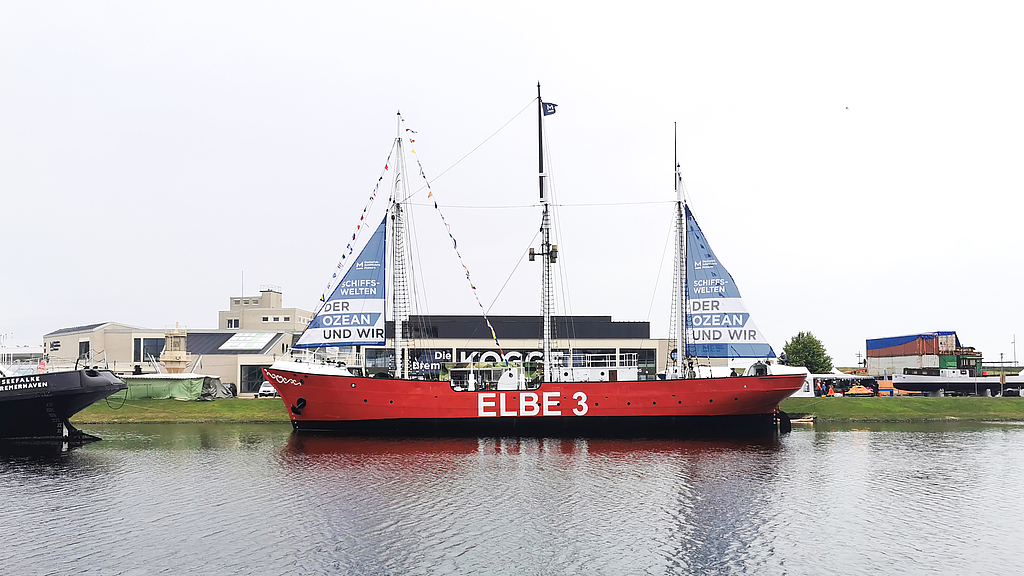
Die ELBE 3 im Museumshafen.
Credit: DSM / Annica Müllenberg