Is the sea still healthy?
A researcher from the German Maritime Museum (DSM) / Leibniz Institute for Maritime History has published her first article in the United Nations’ World Ocean Assessment Report.
This year’s World Oceans Day on 8 June was a special occasion for environmental historian Dr Katrin Kleemann: for the first time, her name appears as a co-author in a United Nations World Ocean Assessment Report. The publication is regarded as one of the most important international assessments of the state of the world’s oceans.
A total of 580 scientists from 86 countries contributed to the third World Ocean Assessment Report, including 284 women. Together, they analysed the current state of the oceans and assessed developments since the second World Ocean Assessment Report, published in 2021.
“I’m actually quite proud to be able to make a scientific contribution to such an important series,” says Kleemann. The historian conducts research at the DSM into the history of the German Hydrographic Office. Her doctoral thesis examined the effects of volcanic eruptions on the environment and climate.
Kleemann spent many months working on her contribution and coordinated it with international colleagues. The report was published just in time for World Oceans Day on 8 June, having previously been reviewed and adopted by 190 nations.
The report describes the ocean as a single, complex and interconnected system – the planet’s ‘life support system’. Biological, physical and chemical processes are intertwined within it and interact closely with the atmosphere. The ocean is home to millions of species, many of which remain unknown.
At the same time, the publication makes it clear that addressing human-induced pressures on the oceans is crucial for the preservation of life on Earth. Despite significant progress, considerable challenges remain. Long-term sustainability therefore requires continuous efforts and further improvements.
For Kleemann, the international collaboration was particularly enriching. “For me personally, it was especially exciting to summarise the current state of research on the different regions. Due to the specified word limits, this had to be done very concisely, which was certainly a challenge,” she explains.
The interdisciplinary perspective was particularly valuable: “As a historian, being part of such an international and interdisciplinary writing team was a wonderful experience. The chapter is primarily concerned with reflecting the current state of academic research since the publication of the second World Ocean Assessment Report. This also includes historical works on ocean history that have been published over the past five years. I was delighted to be able to include the work of several historians, for example on the Southern Ocean, in the report.”
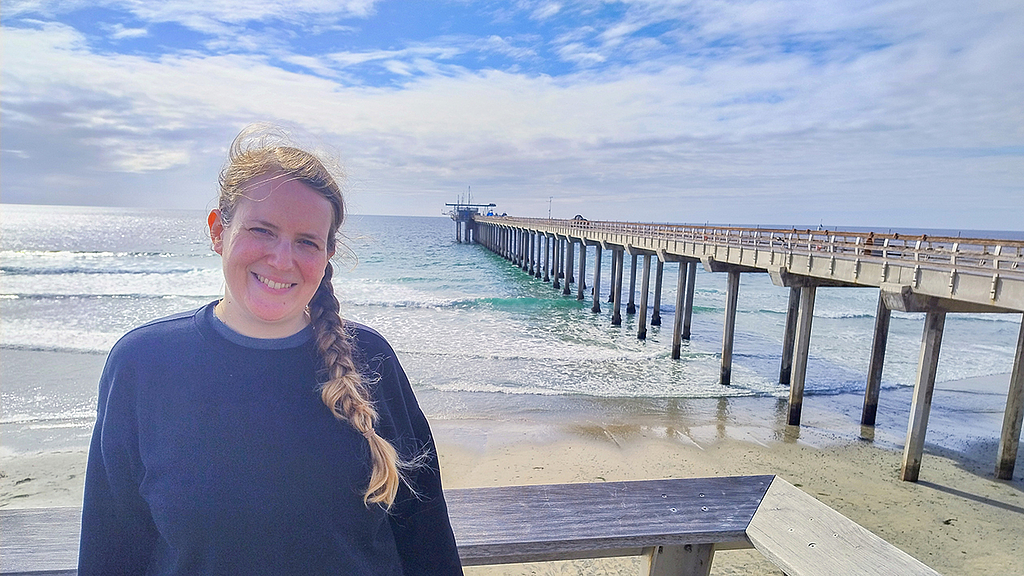
Dr Katrin Kleemann during a research visit to the Pacific coast of California.
Credit: DSM / Annica Müllenberg