First step towards 3D documentation of Bremen’s Weser barges
A special journey for the Bremen Weser barges: to enable these historic 17th-century barges to be documented in 3D using modern techniques, they were moved from the depot of the German Maritime Museum (DSM) / Leibniz Institute for Maritime History to Vechta after 19 years.
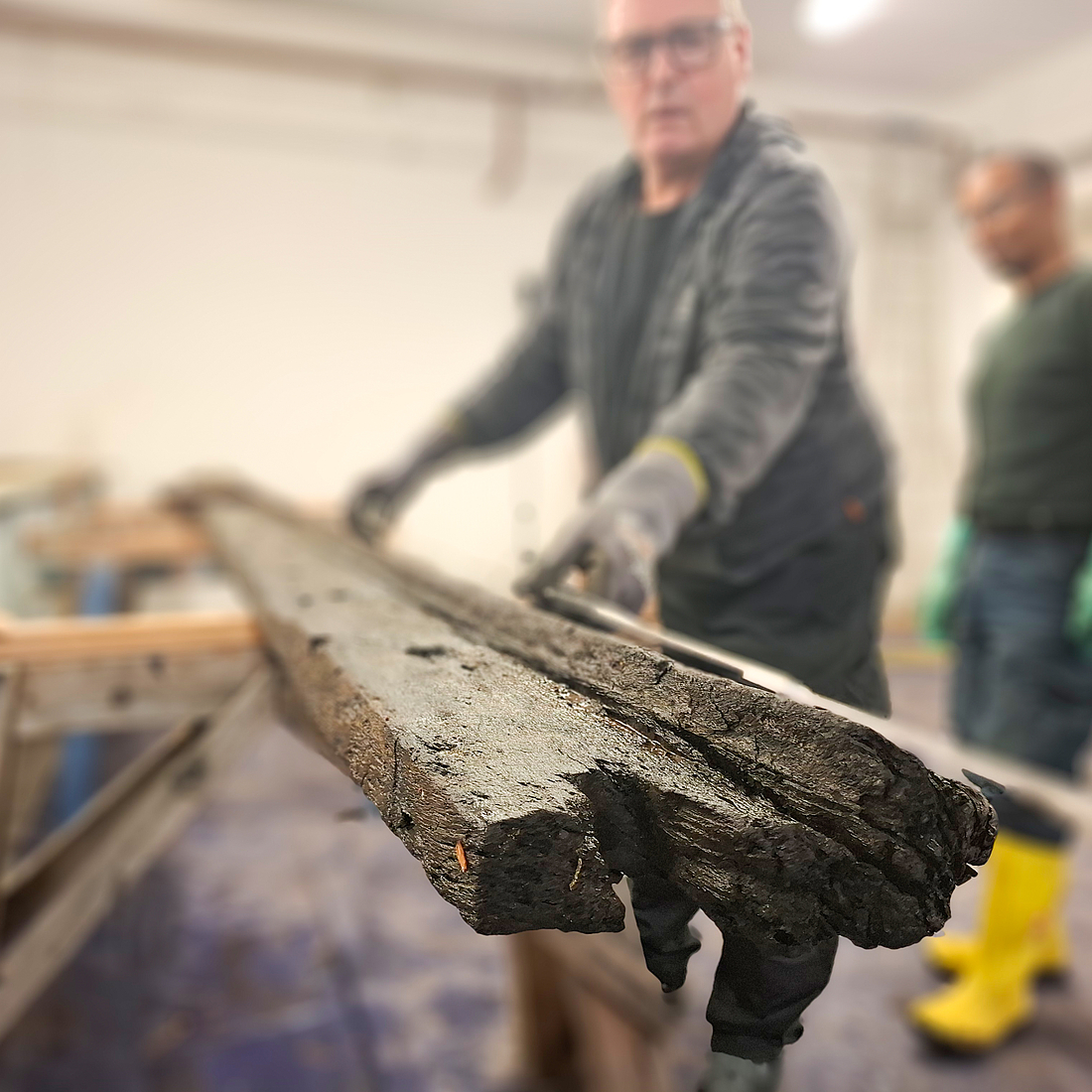
It was a task requiring precise manual work for the DSM researchers, who spent several days in July preparing the more than three-hundred-year-old Weser barges piece by piece for transport. More than 400 wooden components were marked, photographed, professionally packed and transported to the specialist firm Denkmal3D in Vechta. This marks the successful completion of the first stages of the project as planned.
Under the scientific supervision of Dr Mike Belasus from the Lower Saxony Institute for Historical Coastal Research (NIhK), the first step involved applying reversible markings to the wooden components of the barges and systematically cataloguing them. This was followed by comprehensive photographic documentation. This work forms the basis for the subsequent digital 3D surveying and scientific analysis.
Immediately upon their arrival in Vechta, the timber was placed in prepared freshwater tanks in the storage hall. This ensured professional temporary storage under conditions suitable for conservation until further processing. In the meantime, the documentation laboratory in Vechta has been set up and work on the boat parts has begun. Before being scanned using a line-scan scanner, the timber is carefully cleaned to ensure that all details are visible in the image. At the same time, samples are taken – for example, of sealing materials, residues of possible paintwork and other materials that have been preserved within the ships’ structure – which may provide insights into the construction methods and economic practices of the shipbuilders on the River Weser. Sampling deposits between the ship’s components also opens up the potential for drawing conclusions about the ships’ possible cargoes. Samples of the timber used in construction can, furthermore, reveal information about the exact age of the ships, their service life and the origin of the trees used, based on the individual pattern of the growth rings.
Dr Belasus will carry out the detailed survey and scientific documentation of the wooden components by the end of the year. The data he collects will form the basis for a detailed interdisciplinary analysis and study of the Weser vessels in accordance with current international standards in maritime archaeology. The digital and scientific analysis of the shipwreck finds will play a central role in this process. The high-resolution 3D surveying and examination of the Bremen Weser barges thus make an important contribution to the research and long-term preservation of this significant maritime cultural heritage. The results of the current investigations into the two barges from the Weser, which were discovered just a short distance upstream from the site where the ‘Bremer Kogge’ was found, will be presented to the public once the work has been completed.
As part of the project, the DSM is collaborating with renowned national and international partners, such as the Lower Saxony Institute for Historical Coastal Research, the specialist consultancy for archaeology and surveying Denkmal3D, the School of Mechanical and Materials Engineering at University College Dublin, and the Bremen State Archaeological Service.
The documentation project is made possible by funding from the Cultural Foundation of the German States and the Karin and Uwe Hollweg Foundation.
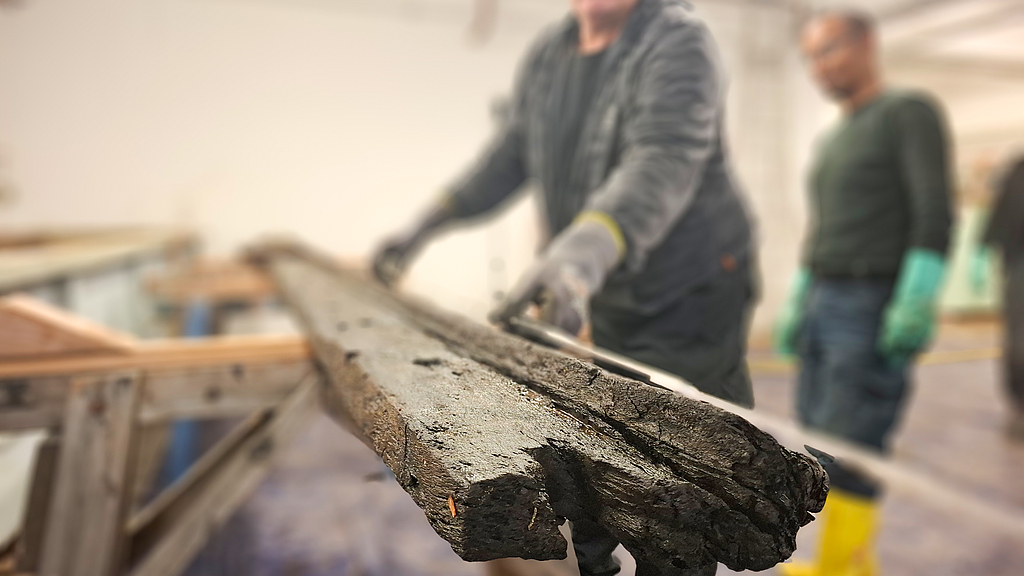
Wooden components of a Weser barge.
Credit: DSM / Annica Müllenberg
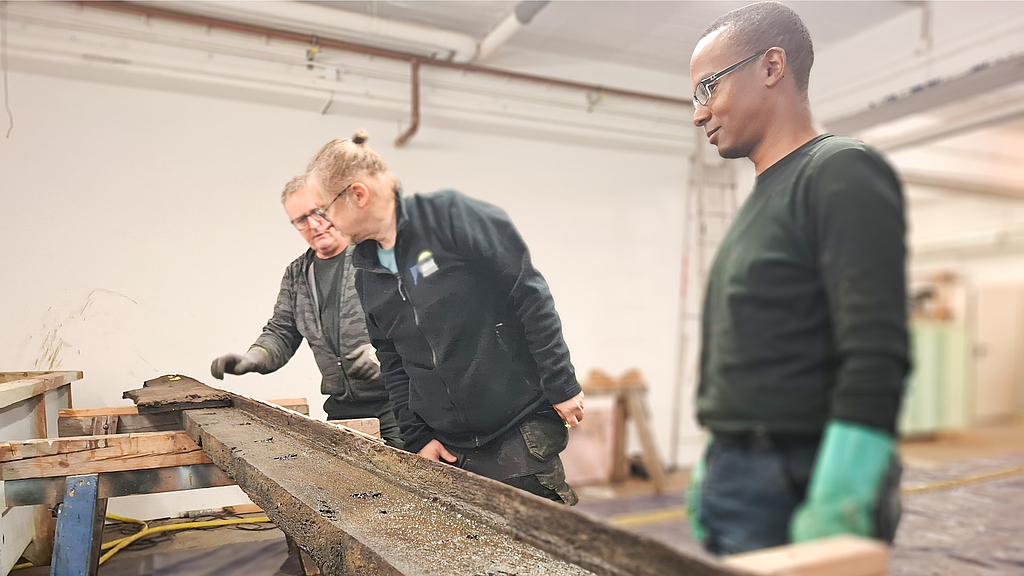
Dr Mike Belasus (centre) and Dr Ferderic Theis (right) are inspecting the wooden components.
Credit: DSM / Annica Müllenberg